About Us
“Outward Bound Costa Rica inspires and develops leadership, compassion, responsibility, respect for the environment and commitment to serve through adventure-based wilderness experiences led by a skilled, safety-conscious staff.”
Outward Bound [OB]
Outward Bound was founded in 1941 in the tumultuous waters of the North Sea during World War II, to provide young sailors with the experiences and skills necessary to survive at sea. Named after the nautical term for a ship’s departure from the certainties of the harbor, Outward Bound was a joint effort between British shipping magnate Sir Lawrence Holt and progressive German educator Kurt Hahn, (http://www.kurthahn.org/). Hahn had developed his progressive ideas, first as founder of the Salem School in Germany, and later at Gordonstoun, a boarding school in Scotland, that soon became one of Britain’s most distinguished and innovative schools. Hahn believed education must encompass both the intellect and character of a person. In creating the first Outward Bound School, he was able to utilize the experiential learning model to employ real and powerful experiences as a means to gain self-esteem, discover innate abilities, and cultivate a sense of responsibility toward others. Outward Bound has since become the premier adventure-based education program in the world.
There are currently Outward Bound schools in 43 countries across the globe, each learning how to best use the practices and philosophy of Outward Bound to fit their local needs. The result is a larger tapestry of ideas and course types that seek to fulfill the core values of Outward Bound and adapt for the times.
OB within Costa Rica
In September 1991, fifty years after Hahn founded OB, a Coloradoan named Jim Rowe traveled to Costa Rica by land after working as an instructor for Colorado Outward Bound School (COBS). The first year in Costa Rica he focused on learning first-hand indigenous culture, rainforest ecology, and Costa Rican geography. He returned the second year with a single raft and some scuba diving equipment to begin an adventure activities company.
Rowe’s third year saw expansion with equipment, river rafting, and mountaineering surrounding his central location in Quepos, which had three uncrowded rivers ideal for rafting. Running day trips on the rivers helped him build the capital needed to establish a school for running courses more relevant to his philosophical approach to instructing. Sowly, he started leading trips whose objectives were to learn through adventure. He founded Save the Rainforest Expeditions School (STRES) to provide a route to work with youth while applying the same philosophies as he used at COBS. STRES strived to focus on teaching self-reliance, leadership, compassion, and service in a Costa Rican environment.
In 1994, Rowe applied for and received a provisional charter, which would become a permanent charter after three years dependent on the ability to adhere to Outward Bound International’s (OBI) policies and procedures.
In September 1997, OBCR received a full charter from Outward Bound International. OBCR is established within Costa Rica as a fundación, and does not have any designation assigned by the US IRS.
Since 1997, we have honed our approach to experiential education in Central America as an Outward Bound school to uniquely leverage the physical challenges of the natural environment here. We strive to provide the opportunity for individuals and groups to understand their personal values and build a sense of self worth. Our staff is knowledgeable and passionate about the local environment, outdoor activities, and conservation.
An Outward Bound Leader
We continue to embrace Kurt Hahn’s educational theories and principals to develop future leaders. But what is a leader? Perhaps a citizen who devotes himself or herself to being well rounded and socially responsible. Or perhaps a person who confronts challenges with imagination and innovation. Or perhaps an individual who seeks to strengthen the body as well as the mind at all times. Perhaps a leader is all of these things.
Our instructors lead by example to develop five “tenets of education” in students: an enterprising curiosity, an indefatigable spirit, tenacity in pursuit, readiness for sensible self-denial, and above all, compassion. By demonstrating what it means to be an Outward Bound Leader, instructors are able to instill in students the ability to create an environment of trust and mutual respect, to build a strong team-oriented group, and provide opportunities for personal growth.
An Enterprising Curiosity
Seeking out new ideas or methods and not accepting outdated practices as efficient or effective for their present challenge;
An Indefatigable Spirit
Continually maintaining a positive outlook and encouraging groups in periods of low morale
Tenacity In Pursuit
Refusing to resign during hardship and preserving past the point of perceived personal limits
Readiness For Sensible Self-Denial
Accepting reasonable personal sacrifices for the betterment of the group and foregoing focus on personal needs or aims in exchange for the advancement of the common cause
Compassion
Demonstrating genuine empathy & care and seeing other’s point of view
The Outward Bound Way
Step By Step
Each course starts with group-oriented, confidence building activities to encourage group formation and decision-making. As the group develops the capacity to do so, the instructors empower the group to take on more responsibility. We use an experiential learning model while teaching our students so they can apply the lessons learned at Outward Bound both on course and beyond in the lives.
Experiential Education & Learning
Aristotle once said, “For the things we have to learn before we can do them, we learn by doing them.”
Experiential learning is creating meaning through direct experience as contrasted with rote or didactic learning. British psychologist David A. Kolb’s work describing experiential learning illustrates the Outward Bound Way: Concrete Experience to Reflective Observation to Abstract Conceptualization to Active Experimentation and starting over again with another Concrete Experience.
How We Teach
Experience [Concrete Experience]
Engage in challenging, adrenaline pumping activities or compassionate service work in a safe environment. Each day, students take on different leadership roles where they will practice responsibility and self-reliance.
Reflect [Reflective Observation]
Instructors debrief each night with students to initiate the reflection process, work through communication issues, and discuss leadership styles. Students go to bed with both an abstract and experience-specific understanding of the challenges from the day.
Conclude [Abstract Conceptualization]
Through hearing peer perspectives at group debriefings and self-reflecting on the solo, students are encouraged to determine how each experience applies to their lives after course. Questions include: Did you notice…? Why did that happen? Does that happen in life? Why does that happen? How can you use that?
Apply [Active Experimentation]
Students wake up ready to test new conclusions during the upcoming day’s challenge and call to leadership.
Student’s Commitment
Personal growth is not forced upon students nor is it easy to accomplish. Instructors, staff, and fellow group members encourage students to put forth their strongest effort possible. In the end, the students who gain the most from our courses willingly and actively involve themselves in the experience, the reflection process, group discussions, and fearlessly try to build on what they learn.
In the end, the students who gain the most from our courses willingly and actively involve themselves in the experience, are able to reflect on the experience, possess and use analytical skills to conceptualize the experience, and possess decision-making and problem solving skills in order to use the new ideas gained from the experience. We know these are very mature concepts to understand and implement. Our instructors are trained and equipped to walk students through these processes.
Example of Experiential Learning
A day or two on the river can illustrate the experiential learning process. A group of students rafting for the first time ever start out on smooth water, and go through a series of small rapids that test their nerves. During lunch, one student comments how they felt they weren’t strong enough to paddle and they felt out of control. The instructor asks if the rest of the raft felt the same – a lot of them do! The instructor takes the opportunity to talk about how, together, a group of students can be very strong. He suggests the students watch their raft mates and paddle at the same time in the same direction. Back on the river, the students are able to test out different conclusions about paddling as a group.
A more advanced semester group is heading to the river for a 3-day camping & rafting expedition. The instructor knows the rapids are not that strong at the beginning and the students have already had classes on river safety. He asks if anyone wants to try guiding the raft. Almost all of the students jump at the opportunity to try what it feels like. The first student guides the raft in circles. The second student who has been observing tries her hand – she guides the raft sideways into a rapid, thinking it will be a higher ratio of raft area hitting the rapid at once and will keep it stable – the raft flips over. On shore, the instructor asks what kind of techniques
- group dynamics during
A third example of experiential learning is learning how to ride a bike, a process which can illustrate the widely known four-step experiential learning model. In the “concrete experience” stage, the learner physically experiences the bike in the “here-and-now”. This experience forms “the basis for observation and reflection” and he or she has the opportunity to consider what is working or failing (reflective observation), and think about ways to improve on the next attempt made at riding it (abstract conceptualization). Every new attempt to ride is informed by a cyclical pattern of previous experience, thought and reflection (active experimentation).
Leadership Roles’ Responsibilities
Everyday, students are given the opportunity to thrive in genuine leadership situations and gain practical experience in leading a group toward common goals. Rotating roles provide a medium through which every student has a different opportunity to hone their own leadership style.
At the end of each day, the group meets to give positive feedback and constructive criticism to each other’s performance in their role. Students are instructed both on how to discuss leadership in a non-offensive manner as well as how to accept feedback in a useful & gracious manner. These discussions often offer the opportunity for students to empathize with their course-mates and how they would react in similar situations and actually react when they themselves are in that role.

Cacique – Leader
Punctuality, facilitating group decisions, liaising with instructors, receptively interpreting group dynamics and responding in a reasonable manner for the wellbeing of the group.

Hanashita – Scribe
Recording the group experiences of the day; examples are poems, stories, ad libs, drawings, and quotes.

Cocinero – Cook & Food Prep
Cooking and preparing meals on course; helping homestay hosts prepare meals.

Trapo – Cleaner
Cleaning up communal dishes and equipment after meals and activities.
Shaman – Health
Carrying medical kit; ensuring course-mates stay hydrated and are eating enough.
Naturalista – Naturalist
Researching and presenting nightly lessons on the flora and fauna of the area.
Profesor – Professor
Researching and presenting nightly lessons on the culture, history, and language of Costa Rica.
Local Involvement
Promoting social and environmental responsibility is one of the core elements of any Outward Bound course. As an organization, we strive to meet this responsibility ourselves and do our part every day on and off course.
Our commitment to generating an organizational consciousness has created initiatives that promote outdoor safety at a national level, leadership development of the nation’s youth, and environmental sustainability practices on base. These initiatives have not only benefited the local community, but have also fostered greater compassion and fostered cultural competence for Outward Bound Costa Rica participants & staff that join from all parts of the world.
Training Park Rangers
Outward Bound instructors are world renowned for being highly trained in both soft and technical skills. The Costa Rican government, however, does not provide such holistic training to its park rangers who, in many parts of the Costa Rican wilderness, are the first responders to emergencies. Years ago, Outward Bound staff caught wind of fatalities that could have been avoided had park rangers been properly trained in CPR, First Aid or Water Rescue. Our Programming Director Danny Jimenez strives to work with the national nonprofit Pro Parques to train volunteers and professionals in the Outward Bound technical skills that make for safe and enjoyable wilderness settings for Costa Ricans and tourists both.
According to Danny, the training seeks to “change the mentality of park rangers, getting them to see their role as more of a profession rather than a volunteer position.” The most recent training was held at Irazu Volcano and served over 20 park rangers, preparing them to be better first responders, including mastering rope rescue, reading GPS coordinates to locate a lost person and implementing first aid and CPR. This pro bono training is in its second year, and occurs once a month for three days at a time. To date OBCR has trained and certified over 250 park service personnel in first aid, CPR, life guarding, vertical rescue and expedition.
Increasing Access to Outdoor Education
Outward Bound Costa Rica sponsors facility maintenance, equipment, and staff training to effectively and safely run the Iztaru Climbing Wall. Our instructors team up with the climbing wall staff and volunteers to develop character and leadership skills in Costa Rica’s at-risk youth population. Local events serve over 18,000 Costa Rican youth each year through Iztaru Scout Camp.
ASO BI TICO – the Costa Rican IB Program
Every International Baccalaureate (IB) high school student studying in Costa Rica spends 3 days at our Tres Riós base with his or her classmates to partake in a highly discounted Outward Bound course. They work on team building activities, develop leadership skills, and increase their exposure to high-adventure, outdoor activities.
Combating Deforestation in Costa Rica
Since 1950, about 60% of rainforest deforestation in Costa Rica has been driven by the United States’ demand for hamburger meat. Cattle ranches have slowly replaced lush foliage here, disrupting the natural ecosystem and facilitating the erosion of soil. Costa Rica has been referred to by National Geographic as the “most biologically intense place on Earth” and has consequently been the focus of many ‘save the rainforest’ campaigns since the 1970s. However, despite efforts to improve conservation of the many National Parks, Costa Rica still has one of the world’s highest deforestation rates at nearly 4% per year. To work towards combating deforestation activities, we do not serve beef products to students or staff at our bases or during course. By upholding to the no-beef policy, instructors and staff are given a chance to explain to students how the economics of choice and environmental degradation are so closely linked.
Sustainable Practices
A little closer to our home, we embrace the Costa Rican value of environmental sustainability by supporting nation-wide efforts to compost, recycle, reuse, and repurpose. Our practices include maintaining a chicken coop with more than fifteen chickens that produce fresh and organic eggs for the students’ meals, a small herb garden planted for instructor and staff use, and compost and recycle bins in every dwelling. Retired sea kayaks are remade into desks, whitewater kayaks make great planters on base, and old surfboards get a second life as benches and signs.
Costa Rica & Safety of Students
Costa Rica is a stable, functioning democracy and generally considered to be a very safe country. Most of the existing crime tends to be opportunistic (pick-pocketing and mugging) and generally occurs in the larger cities at night. Students are never left unattended and do not carry their valuables outside of base. The safety of our students and staff is paramount on every course and it is highly unlikely that any student would be a victim of a crime.
Naturally, there are perceived and actual risks inherent to any outdoor adventure activity or program. We use risk management systems based on Outward Bound International standards, which are incorporated into staff training, evacuation procedures, and program policy.
In addition to training on the Outward Bound philosophy, every course instructor is required to be certified in CPR/AED for the Professional Rescuer and in Wilderness First Responder (WFR). In addition, instructors hold the training and certifications necessary for their specific activity of instruction: Waterfront Lifeguarding, Scuba: National Association of Underwater Instructors (NAUI), Whitewater Rescue Technician, Technical Rope Rescue, Whitewater Raft Guide License, Outward Bound Costa Rica Land Instructor Training, and Outward Bound Costa Rica Instructor Judgment Training.
As the leading adventure-based education program in the world, we have developed and refined our safety procedures and program reviews over seven decades during which time over 6 million participants have experienced Outward Bound. Since each Outward Bound Center seeks to have high standards of risk management, we have developed a number of voluntary procedures designed to reduce the likelihood of accidents and incidents in every country where Outward Bound programs take place:
Program Reviewing:
Every two years* each of our member Centers are reviewed by a team of experienced peers external to the Center. This may result in specific feedback for improvement of the Center’s risk management practice. If a serious issue were identified a Center may be placed on probation or have its license revoked.
Safety Training:
Each Center trains its staff in skills needed for the environments in which it operates. Outward Bound Centers exchange information about current risk management practices through electronic exchanges and at conferences and symposia.
Safety Resources:
Each Center has policies and procedures for their activities. These are reviewed by Outward Bound International during the program reviews.
Safety Infrastructure:
The Board of Directors of each Center pays attention to risk management issues as part of its governance responsibility. Each Center is encouraged to have an accident and incident reporting system to track trends and help prevent future incidents. Centers have medical screening processes to try and identify participants who have medical problems that could be aggravated by a particular course.
Staffing:
Staff skill requirements are set by each Center. Centers also have an instructor development process that is appropriate to the activity type and skill level required.
Summary of Safety Responsibility:
As is evident from the above, risk management and safety of participants at a Center is the responsibility of that Center, not of Outward Bound International or any other Outward Bound organization. Each Center is a separately incorporated not-for-profit entity in the country where it is licensed. Participants should make inquiries to satisfy themselves regarding risk management practices at the Center in which they are interested.

Our Base Camps
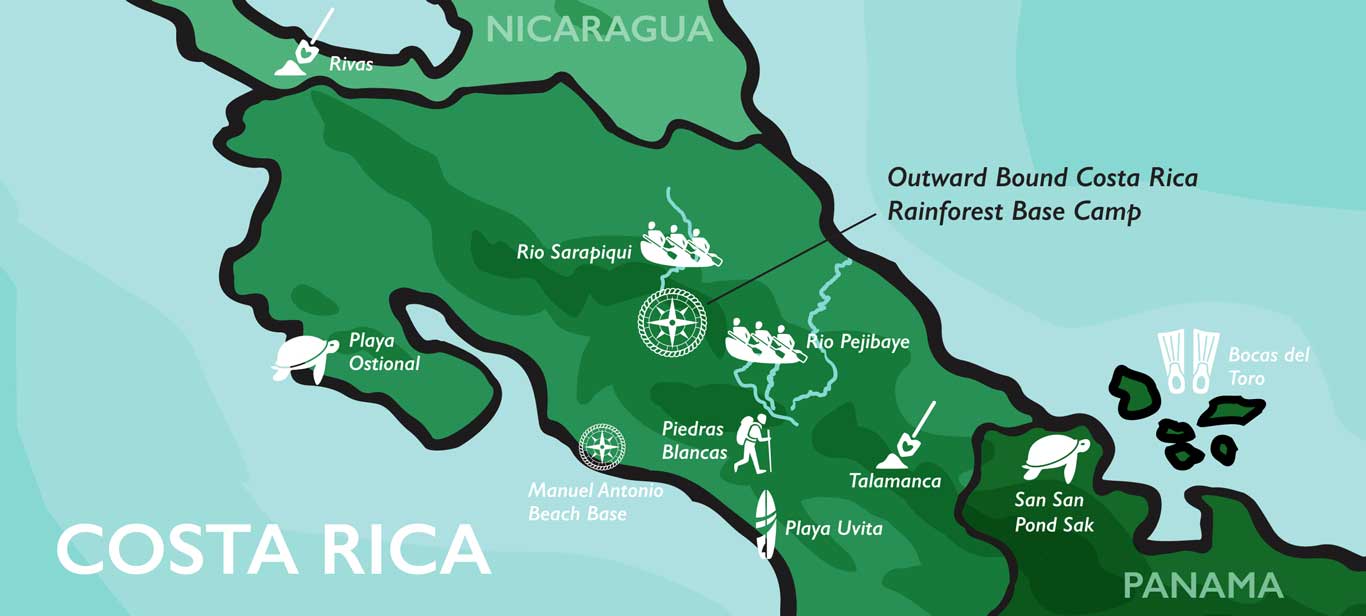
Our rainforest base facility is located in Tres Rios, about 15km east of Costa Rica’s capital city, San Jose. All groups arrive to this base for orientation & duffle shuffle, and before leaving the country. Our programming and communications offices, equipment and food bodega, communications staff housing, instructor housing, student dorms, student kitchen, and meeting spaces are located at this base. Special features include a nature reserve with running paths, a bubbling river, space for volleyball and soccer, and a chicken coop supplying eggs for meals.
Our beach base facility is located 3 miles from the Manuel Antonio National Park & beach. Groups doing beach activities will stay at this beautiful coastal rainforest base. If you go here, watch out for the monkeys! Howler, Titi, and White-faced monkeys have all been spotted from the front porch.
Faces & Histories
Instructors
Each course is accompanied by at least two instructors, with a maximum ratio of 6 students to 1 instructor for risk-bearing activities. In most cases one instructor is a Costa Rican National who brings a vital cultural and linguistic element to the overall course experience. These instructors are well versed in the identification of local flora and fauna.
Because safety is a priority, our lead instructors all hold Wilderness First Responder, CPR/AED for the Professional Rescuer, and Waterfront Lifeguard certifications. Technical instructors possess the required certifications necessary for their area(s) of instruction.
Office & Maintenance Staff
Although we all love the outdoors, our staff behind the scenes helps keep things running smooth out in the field.
Board of Directors
As all Fundaciónes in Costa Rica, we are led by a five-person governing board. They help effectively recruit qualified staff, expand program impact, and ensure student safety. These board members generously contribute their time and talent to ensure the ongoing success of Outward Bound Costa Rica and guide us in furthering our mission.
Contact Our Office
Our communications office is open Monday through Friday from 9am – 5pm (GST -6). Any messages left past 5pm or on weekends will be checked the next business morning.
Primary International Number
+1(800) 676-2018 (toll free from US)
Primary Local Number
+506-2278-6062 +506-2278-6058
Email
enrollment@crrobs.org | info@crrobs.org
Fax Number
+506-2278-6055 +1 (866) 374-2483
Emergency Numbers
Communications On-Call Mobile
+506-8423-7448
Communications House
+506-2278-6041
Communication Director Home
+506-2278-6085
Communication Director Mobile
+506-8352-1329
Flyers, Pamphlets, Brochures, Stickers
Links to each here!

Self Reliance
Outward Bound staff today model and teach reliance on one’s own skills and strenghs. The confidence taht comes with knowing that you have the ability to solve your own problems is a critical aspect f being both a secure leader as well as a valuable member of any of any community. Self-reliance does notdictate isolation from or an inability to work with other people; instead it encourages self-sufficiency, innovation, and in hahn’s words, ‘sensible senf-denial’
ie – when a problem arises, offer information so group members rely on themselves to make a decision

Physical fitness
a leader needs to be physically and mentally fit enough to perform any leadesrhip duties that might be required – at the highest level possible. cleaarly, if you’re a wilderness trip leader, the level of fitness you’ll need will be different from that required for the leader of an advocacy group. but outward bound believes that, regardless oftheir leadership responsibilities, the most effective leaders are those who maintain healthyl bodies and clear minds, modeling a balanced life and an attitude of reasonable self-denial.
ie – even when tired, if someone is proactive about physical activity, get ur ass in gear

Craftsmanship
OB’s methods of experiencebased education puts participants in situations wherein the need for specific skills is immediately apparent and wherein the application of these slills for example. reading a map correctly, making a good decision about which route to take, trating a wound properly, interpreting weather patterns accurately – usually results in success. instructors promote cradtsmanship by modeling high-quality work, and they encourage participants to hold themselces to high standards and to take prided in everything they do.
ie – be responsive to changing conditions based on knowledge

Service and compassion
Meeting the needs of another person, group, or community ignites, in kurt’s words, ‘the highest dynamics of the human soul.’ when people throw themselves into working for the common good, sercing their gorup or commmunity, and showing compassion for their fellow human beings, their strongest most admirable selves come forth. even though theirr initial inclination might be just to look out for their own needs 0 oarticularly in challenging or difficult situations – people usually find that by helping others, they discover strength that they didnt know they had.

Outward Bound Costa Rica
Tel: +1(800)676-2018
Fax: +1(866)374-2483
Email: info@OutwardBoundCR.org
P.O. Box 025331 | SJO-829
Miami, FL USA
33102-5331